

Africa's Indigenous Beef Breed, Refined Over Centuries
The Boran is one of Africa's most important indigenous cattle breeds. Its history did not begin in a modern breeding laboratory or with a planned crossbreeding programme. Instead, the breed developed gradually through the interaction of cattle, people and a demanding East African environment.
The Boran is generally classified as an East African Shorthorn Zebu. Its indigenous population is associated most closely with the Borana region of southern Ethiopia, from where related cattle spread into northern and central Kenya and western Somalia.
A second, distinct population, the Improved Kenyan Boran, was later developed under commercial ranching conditions in Kenya.
This distinction is important. The indigenous Ethiopian Boran represents the pastoral foundation of the breed, while the Improved Kenyan Boran reflects decades of organised selection for beef production.
The modern Boran known to many Southern African stud and commercial breeders therefore carries both a deep indigenous heritage and a more recent history of formal performance-based improvement.
The broader ancestry of African cattle is itself complex. FAO historical accounts describe several major cattle migrations into Africa, including early humpless taurine cattle and later humped zebu cattle.
Over centuries, migration and interbreeding produced a variety of locally adapted African populations. The Boran emerged within this wider history of cattle movement through the Nile Valley and the Horn of Africa, regions that became important centres of indigenous cattle diversity.
It is therefore more accurate to describe the Boran as a breed refined over many centuries than to assign it a single founding date. Its identity was shaped by long-term natural selection, pastoral husbandry and, later, organised ranch-based breeding.
The traditional home of the Boran lies on the Borana Plateau of southern Ethiopia. This is a semi-arid rangeland environment characterised by variable rainfall, recurring drought, long travelling distances and uneven access to forage and water.
These conditions placed continuous pressure on cattle. Animals had to survive seasonal feed shortages, walk significant distances, reproduce under environmental stress and remain useful within a pastoral production system. Cattle that could not cope with these demands were less likely to remain within breeding herds.
FAO identifies the indigenous Boran as originating in the Borana Province of southern Ethiopia before spreading into western Somalia and northern and central Kenya. The organisation distinguishes this indigenous population from the Improved Boran later developed in Kenya.
The Borana Plateau was not merely the geographical setting in which the breed developed. Its environmental pressures played an active role in shaping the cattle. Long-term exposure to semi-arid conditions favoured animals capable of maintaining themselves on natural grazing, travelling in search of water and recovering after difficult seasons.
Research on Ethiopian Boran breeding confirms that the breed's primary habitat includes the southern Ethiopian rangelands around areas such as Liben, Mega and Arero. These areas range from semi-arid to arid, with limited water and recurring droughts. Despite these restrictions, the region has historically supported productive pastoral cattle systems.
The Boran's reputation for adaptability is therefore not based solely on modern marketing. It is rooted in the environment from which the breed emerged.
The development of the Boran cannot be separated from the Borana pastoralists who kept and selected these cattle over generations.
Cattle traditionally occupied a central position in Borana life. They provided milk, meat, social value, wealth and security. Research into Borana pastoral systems indicates that livestock, and especially cattle, formed the foundation of household subsistence and regional economic activity.
The Borana developed sophisticated systems for managing grazing, water and herd movement. Deep wells, seasonal ponds and communal grazing territories allowed cattle to use resources spread across a large and variable landscape. Access to water and grazing was not random; it was linked to established social systems and collective resource management.
This pastoral knowledge influenced the type of cattle that survived and reproduced. The Borana required animals that could:
Selection was practical. Cattle were valued for their usefulness in the production system rather than for appearance alone. Over generations, this favoured functional fertility, maternal ability, mobility and environmental fitness.
FAO describes the Borana as highly capable cattle managers whose livelihoods depended significantly on milk from their herds. Indigenous Ethiopian Boran cattle were therefore not simply unmanaged animals shaped by nature. They were the product of natural environmental pressure combined with generations of human preference and pastoral selection.
Related Boran populations also moved with pastoral communities into neighbouring regions. For example, the Orma people of Kenya are descendants of Oromo groups associated historically with Ethiopia's Borana region. Their cattle, commonly known as Orma or Tanaland Boran, became established in Kenya's Tana River area. ILRI research identifies these cattle as an indigenous Bos indicus population with a long history under pastoral management in challenging environments.
The spread of cattle alongside pastoral communities contributed to the development of several regional Boran types, each influenced by its environment and management history.
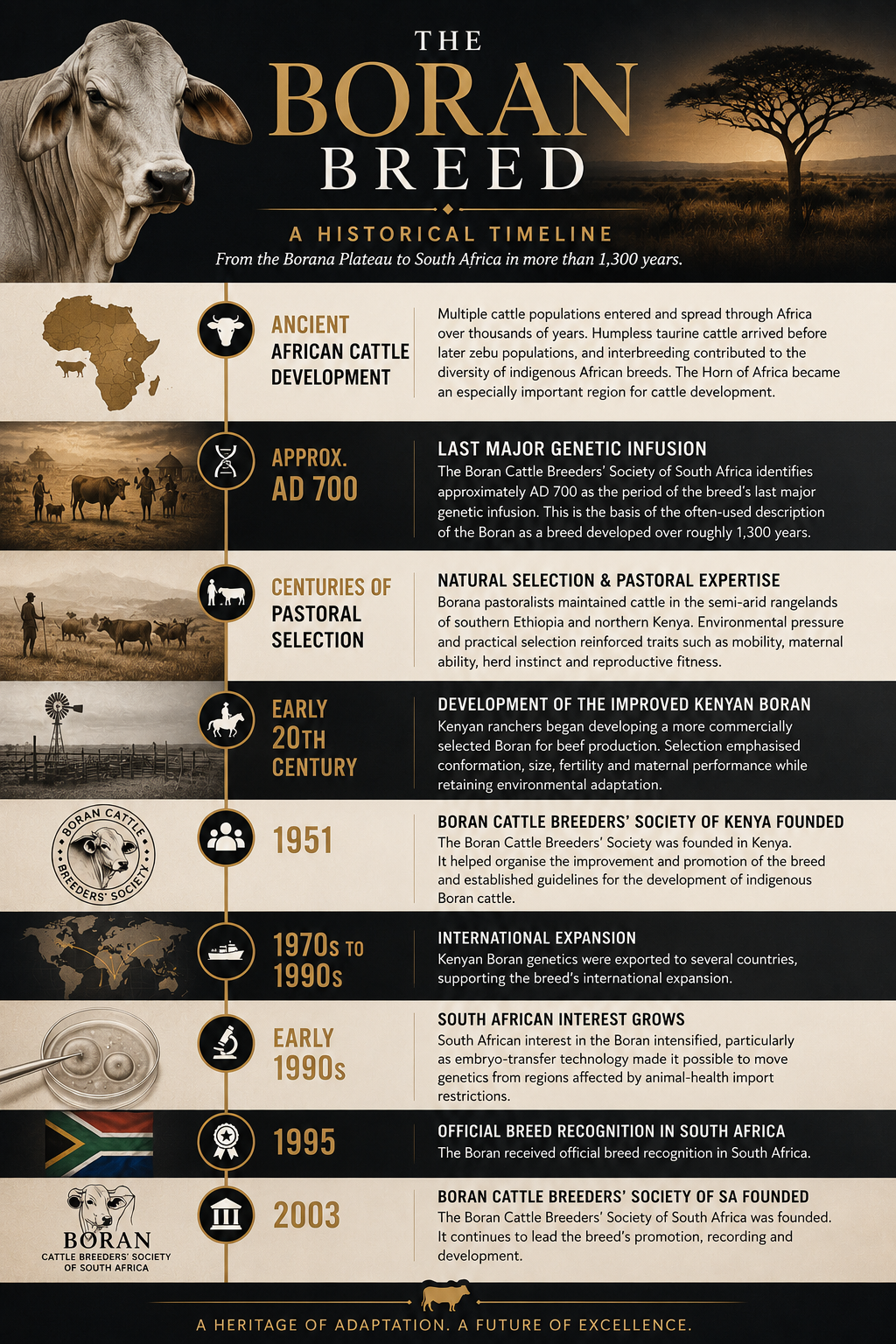
Breed organisations commonly describe the Boran as having developed over approximately 1,300 years. This should not be interpreted as meaning that the breed was formally founded in a particular year. Rather, it refers to the long period over which its recognised genetic and functional identity became established.
The Boran Cattle Breeders' Society of South Africa states that the breed's last significant genetic infusion occurred around AD 700 and that the population was subsequently maintained through selection. This claim forms part of the Society's official account of Boran breed history. It is best presented as the Society's historical interpretation rather than as a precisely dated event established by a single surviving breeding record.
The wider historical evidence supports the main point: the Boran is not a recently manufactured composite. It is a long-established African cattle population whose identity predates modern breed societies and formal herd books.
This long development period matters because consistency within a cattle population is created over many generations. Repeated selection under the same broad environmental pressures tends to establish predictable functional traits. In the Boran, these include the ability to move over extensive rangelands, strong herd behaviour, maternal performance and reproductive fitness under tropical and subtropical conditions.
FAO assessments have recognised Boran cattle for their ability to travel in search of water and grazing, their strong herd instinct, mothering ability, adaptability, fertility and longevity. These traits reflect the production system in which the cattle developed.
The phrase “1,300 years in the making” is therefore useful, provided that it is not presented as an exact scientific birthday. It communicates that the Boran's strengths were established over centuries of survival and selection rather than through a short, modern breeding experiment.
As Boran cattle moved southwards from Ethiopia, they became established across northern Kenya. Different local populations developed, including cattle managed by pastoral communities and cattle that later entered commercial ranching systems.
Kenya would eventually play a decisive role in transforming the Boran into an internationally recognised beef breed. Indigenous cattle provided the genetic and functional foundation, but commercial ranchers introduced more formal selection for production traits.
FAO describes the Improved Kenyan Boran as a population developed in the semi-arid uplands of Kenya through six to seven decades of selection under ranching conditions. Selection focused on characteristics such as size, conformation, fertility and mothering ability.
Some historical literature suggests that limited European influence, particularly Hereford, may have entered certain Kenyan cattle populations during the early twentieth century. However, accounts vary, and this point should be treated cautiously. It would be inaccurate to describe the Improved Kenyan Boran simply as a modern European cross. Its recognised identity, adaptation and maternal foundation remained overwhelmingly rooted in indigenous Boran cattle.
The central achievement of the Kenyan programme was not the replacement of the indigenous breed. It was the improvement of an African breed while retaining the traits that made it valuable under African conditions.
During the early twentieth century, Kenyan ranchers began selecting Boran cattle more deliberately for commercial beef production. Their aim was to produce cattle with improved body capacity, muscling and market suitability without sacrificing fertility, hardiness or maternal ability.
The result became known as the Improved Kenyan Boran.
This was a significant development in African livestock breeding. Instead of assuming that productivity could only be improved by replacing indigenous cattle with imported European breeds, Kenyan breeders built on the strengths of a locally adapted population.
Formal organisation followed. The Boran Cattle Breeders' Society in Kenya was founded in 1951 and became an important force in establishing selection guidelines, breed identity and organised improvement. FAO credits the Society's programme with supporting the development of the Kenyan Boran as a major beef breed in East Africa.
Under commercial ranching conditions, breeders selected animals for:
Over time, the Improved Kenyan Boran became more uniform and commercially recognisable. FAO records describe it as having better-developed hindquarters and carcasses suitable for the beef market. The breed became a leading indigenous beef resource in East Africa and was subsequently exported beyond its original region.
Kenyan Boran genetics were exported to countries including Zambia, Tanzania and Uganda, and later reached more distant cattle industries such as Australia and the United States. The Kenyan Society attributes much of this international distribution to genetic exports made between the 1970s and 1990s.
By the late twentieth century, the Boran had moved beyond its pastoral homeland. It had become a formally recognised African beef breed with international influence—yet its commercial success remained grounded in the functional traits developed on the Borana Plateau.
The Boran attracted South African interest because it appeared suited to many of the country's commercial realities: extensive grazing, periodic drought, heat, variable forage quality and the need for fertile, functional cattle.
However, importing live animals directly from East Africa presented serious animal-health and regulatory challenges. The breed's entry into South Africa therefore depended not only on breeder interest but also on advances in reproductive technology.
The official South African breed history records an early attempt by Miles Fletcher, a prominent Kenyan Boran breeder, to stimulate interest in the breed. During the early 1960s, Fletcher explored the possibility of introducing Boran cattle to South Africa, but conditions at the time did not allow the programme to proceed.
The idea remained alive, however, and later developments in embryo transfer changed what was technically possible.
By the early 1990s, embryo transfer offered a safer way to introduce valuable genetics across disease-sensitive borders. Rather than importing live cattle, embryos could be collected under controlled veterinary conditions, frozen and transferred to recipient cows in an approved destination.
According to the Boran Cattle Breeders' Society of South Africa, renewed efforts began in 1991 when Simon Hodgson contacted the Kenyan breed society regarding the possible importation of Boran genetics into South Africa. The Kenyan Society's leadership then invited a South African cattleman to judge Borans at the 1992 Nairobi Show as part of an effort to increase awareness of the breed.
Douglas Ralfe accepted the invitation and travelled to Kenya with his son, Tim. They judged cattle at the Nairobi Show and visited prominent Boran ranches. Ralfe's later account emphasised that the cattle appeared particularly well suited to the environments in which they were being farmed. He was also impressed by their strong herd instinct and functional type.
These visits were important because they moved South African interest from theory to direct observation. Prospective breeders could assess the cattle in their working environment rather than relying only on promotional descriptions.
The importation route was still complicated. South African authorities were initially reluctant to recognise another cattle breed, and direct entry remained difficult. Embryo work involving selected Kenyan cows therefore became central to the process.
Historical accounts from the Society describe donor cows being flushed in September 1992 and hundreds of frozen embryos being exported to Zimbabwe. From there, the breeding programme helped create a route through which Boran genetics could ultimately become established in Southern Africa.
This episode illustrates the importance of reproductive technology in the Boran's modern history. Without embryo transfer, disease-control regulations could have delayed the breed's arrival for many more years.
The Boran was officially recognised as a cattle breed by South Africa's Department of Animal Improvement in August 1995. This provided the legal and institutional foundation required for breed registration and organised development.
Official recognition did not mean that the breed was already widely established. The early population was limited, and breeders had to expand numbers carefully while protecting the quality and traceability of the available genetics.
Embryo transfer, artificial insemination and structured stud breeding therefore remained important. Early breeders faced the challenge of building a national population from a relatively narrow imported genetic base while also demonstrating the breed's practical value to commercial cattle producers.
Interest grew as farmers observed Boran cattle under South African conditions. The breed's medium frame, maternal ability, herd behaviour and suitability for extensive systems attracted attention. Its potential as both a pure breed and a component of commercial crossbreeding programmes further broadened its appeal.
The South African breed society was formally founded on 17 May 2003. This created a dedicated organisation responsible for breed promotion, breeder support, standards and the orderly development of the registered population.
The establishment of any new breed involves more than increasing animal numbers. A sustainable national population requires:
The Boran Cattle Breeders' Society of South Africa played a central role in this process. It promoted the breed, developed educational material and worked with the national stud-recording system.
The breed's expansion was supported by increasing access to semen and embryos, the growth of registered studs and the use of Boran bulls in commercial cow herds. Breeders were able to introduce additional lines while selecting animals suited to South African veld and production systems.
The Boran's African origin was especially valuable in its marketing and adoption. It was not presented as an exotic breed requiring the environment to be altered around it. Instead, it was promoted as cattle shaped by African conditions and capable of contributing to efficient beef production under local realities.
FAO had already identified the Boran as a high-potential indigenous breed deserving conservation and further improvement. Its assessment highlighted the breed's value in beef production under variable tropical conditions and encouraged its responsible expansion as both a pure breed and a genetic resource.
The Boran's influence has grown not only through registered herds but also through commercial crossbreeding.
The breed is valued as a maternal and adaptive component in crossbred herds. Commercial producers may use Boran genetics to introduce environmental fitness, fertility, mothering ability and functional structure while combining these traits with complementary characteristics from another breed.
FAO literature has long recognised the potential value of Boran cattle in crossbreeding systems, including crosses between Boran and European beef breeds under East African conditions.
However, the breed's importance should not be reduced to its role in crossing. Registered purebred herds remain essential because they preserve the genetic resource, allow structured selection and provide predictable breeding material to both stud and commercial operations.
The South African Boran population now forms part of a wider international breed community whose history links Ethiopia, Kenya and Southern Africa. The movement of embryos, semen and breeding knowledge has allowed the breed to reach new environments while retaining its African identity.
The history of the Boran is ultimately a story of continuity and adaptation.
The cattle began as an indigenous pastoral population shaped on the Borana Plateau. Borana communities selected and managed them as a source of milk, wealth and survival. Kenyan ranchers later applied organised beef selection and developed the Improved Kenyan Boran. Breed societies formalised standards and recording, while reproductive technology allowed the genetics to move across international borders.
South Africa then added another chapter. Through the persistence of early breeders, embryo-transfer technology, official recognition in 1995 and the creation of a national breed society in 2003, the Boran became an established part of the country's beef-cattle industry.
What makes this history distinctive is that modern improvement did not erase the breed's indigenous foundation. The traits valued today, fertility, maternal ability, adaptability, mobility and longevity, are closely connected to the environment and pastoral system in which the cattle developed.
The Boran therefore represents more than a collection of desirable production traits. It is a living African genetic resource, formed through centuries of human knowledge, natural selection and disciplined breeding.
Its enduring relevance lies in the balance it offers: indigenous adaptation combined with structured modern improvement. More than a thousand years after its development began, the Boran continues to demonstrate that cattle bred for real African conditions can also meet the demands of modern commercial beef production.